Table of Content
- Home Owners' Loan Corporation Law and Legal Definition
- Statement by the President on the Record of the Home Owners' Loan Corporation
- What brought about Home Owner Loan Corporation?
- What Is Home Owners Loan Corporation?
- how did the home owners loan corporation help
- Who did the Home Owners Loan Corporation HOLC help?
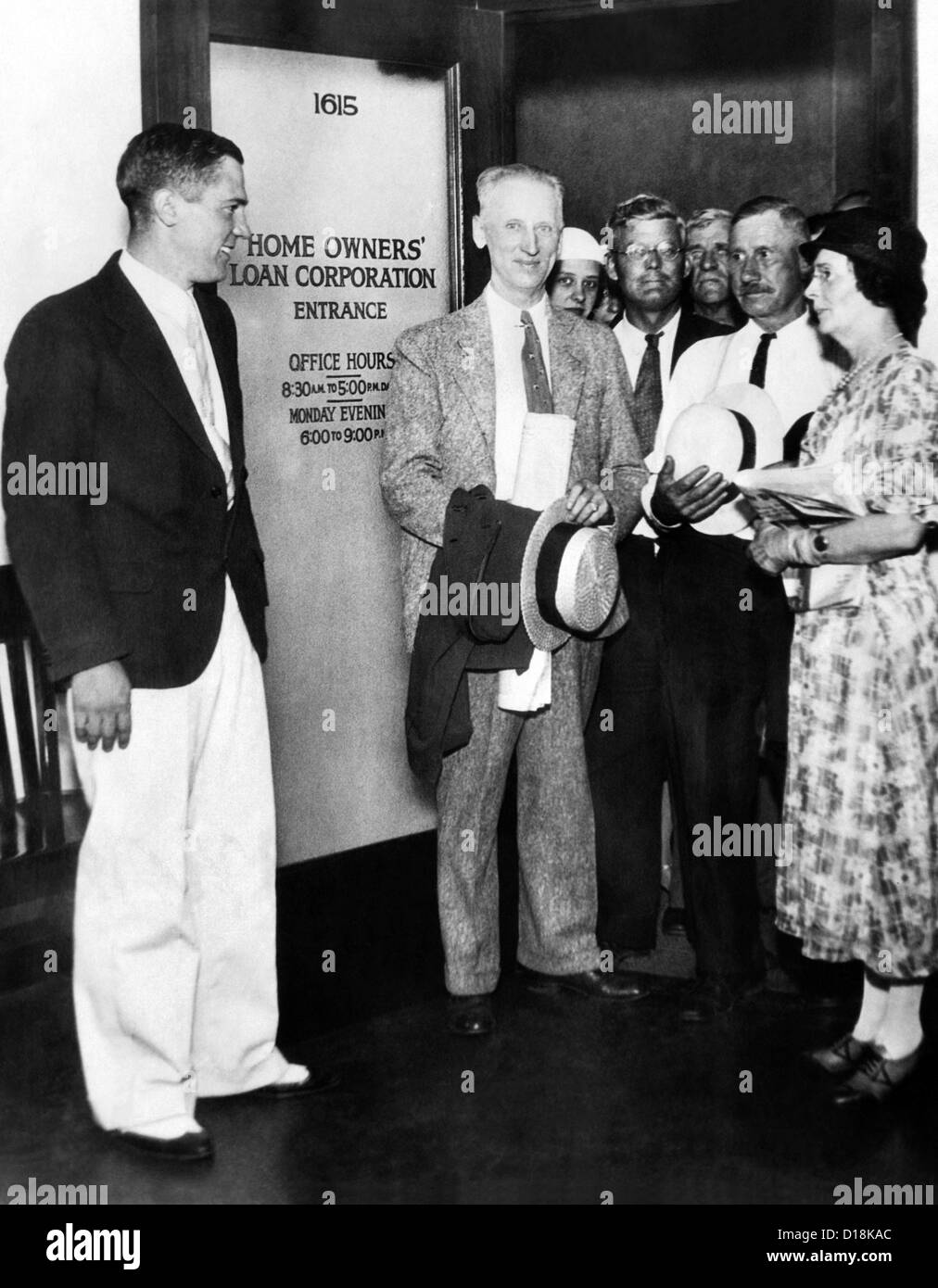
Perhaps ironically, HOLC had issued refinancing loans to African American homeowners in its initial "rescue" phase before it started making its redlining maps. The racist attitudes and language found in HOLC appraisal sheets and Residential Security Maps created by the HOLC gave federal support to real-estate practices that helped segregate American housing throughout the 20th century. When the HOLC was started some .people expressed the fear that the experiment of direct Government lending to homeowners in default on their mortgages and taxes might cost the Treasury huge losses. They knew that through vigorous public and private action the downward spiral of depression could be reversed, and that these loans would be sound assets which would be repaid in full. HOME OWNERS' LOAN CORPORATION. For middle-class America the Home Owners' Loan Corporation, founded in 1933, was a crucial New Deal benefit. Americans had always held to an ideal of individualism that included a home of one's own; but in the years leading up to the New Deal, only four out of every ten Americans managed to attain that status.
Furthermore, the HOLC program aided city and town governments in meeting their payrolls and keeping up their essential services. As payment for the overdue taxes of HOLC borrowers, local governments received nearly half a billion dollars in less than 3 years. The Home Owners' Loan Act was one of the emergency measures passed during the first days of the Democratic administration in 1933. Foreclosures on city homes were then running at the rate of 1,000 every day. “Type B” neighborhoods, outlined in blue, were considered “Still Desirable”, whereas older “Type C” were labeled “Declining” and outlined in yellow.
Home Owners' Loan Corporation Law and Legal Definition
Consequently, the term of the loan could not change unless the loanee did not pay the loan. Due to the fact that HOLC obtains loans by providing a bond value equal to the amount of principal owing by the borrower, most of the lenders have benefited from the sale of their loans. This is because of the high-interest rate which if not paid at the right time, accumulates. Home Owner’s Loan Corporation was established to help manage this situation. Before the pandemic devastated minority communities, banks and government officials starved them of capital.

Additionally, most of the HOLC graded “Hazardous” areas (nearly 64%) are minority neighborhoods now. In 3 years the HOLC refunded the overdue mortgages of more than 1 million families with long-term loans at lower interest rates. FHA loans—mortgages insured by the Federal Housing Administration and issued by an FHA-approved lender—are still in existence today. Designed for low-to-moderate-income borrowers, they require a lower minimum down payment and lower credit scores than many conventional mortgages. The HOLC tried to prevent selling too many houses in a short time in order to prevent negative impacts on the housing market. Overall, over 800,000 people paid back the HOLC loan, while a majority paid them off early enough.
Statement by the President on the Record of the Home Owners' Loan Corporation
By that time, the HOLC had made 1,021,587 loans, making it the owner of approximately one-sixth of the urban home mortgage debt in the United States. The HOLC's operations were not officially terminated until February 3, 1954. Eighty years ago, a federal agency, the Home Owners’ Loan Corporation , created “Residential Security” maps of major American cities.
This emergency federal agency provided mortgage assistance to homeowners by lending low-interest money, refinancing mortgages, and originating new mortgages. HOLC issued government insured bonds to local lenders in exchange for delinquent mortgages in their portfolios. One of the lesser-known programs of President Franklin Delano Roosevelt's New Deal, the Home Owners Loan Corporation was established in 1933 to help struggling homeowners pay their mortgages. In cities and towns nationwide, the HOLC used government bonds to buy out mortgages from banks and then worked with borrowers to refinance them ... The standard HOLC loan prior to 1940, was an amortized 15 year loan, in contrast to the 3-year mortgages that were that commercial banks offered and the loans of years that were offered from Building and Loans in the 1920s. The interest rate for first HOLC loan was five percent at the time when mortgage loans were offered with an interest rate between 6 and 8 percent.
What brought about Home Owner Loan Corporation?
Instead, the agency purchased and refinanced mortgages in default or foreclosure from financial institutions . In exchange for mortgages, the HOLC gave lenders government bonds paying 4 percent interest . Treasury, the HOLC was authorized to issue $2 billion in bonds, an amount eventually increased to $4.75 billion. During a peak period in the spring of 1934, it processed over 35,000 loan applications per week and employed almost 21,000 people in 458 offices throughout the country. The law authorizing the HOLC's lending activities expired on June 12, 1936.
A key reason for the majority's failure was the restrictive mortgage system. Usually, borrowers were required to make down payments averaging around 35 percent for loans lasting only five to ten years at interest of up to 8 percent. At the end of that brief loan period, mortgage holders had to hope they could refinance or else come up with the remaining cost of the property.
What was bad about the Home Owners Loan Corporation?
The HOLC shut down its operations April 30th of 1951 with “a slight profit,” contrary to the belief that taxpayer money will be lost in this business [88. The Home Owners Loan Act in 1933 turned out to be among the most popular policies to emerge in the initial 100 days in the New Deal. Here You got Some Questions Which people Ask Most of the time on Google. HOLC was only available to homes owned by nonfarm owners, valued not more than $25,000.
The loans were purchased to homeowners who were having difficulties paying the bills on the mortgage loan “through not their fault”. A majority of the lenders profited from selling their loans since the HOLC bought the loans offering bonds with a value equal to the principal due by the borrower. The loan’s value represented the value of the loan which was refinanced to the borrower. The borrower benefited because they received a loan with an extended time frame and an interest rate that was lower. The lowest rated neighborhoods—those with high concentrations of racial minorities—were "redlined" by the HOLC, a term denoting an area considered too risky for government mortgage assistance. Redlining was adopted not only by private lenders, but also by public agencies, most notably the Federal Housing Administration , which was part of the National Housing Act of 1934.
In response, Congress rapidly created the Home Owner's Loan Corporation. The HOLC agency was established in the context of the FDR’s New Deal Programs that encompassed his plans that included Relief, Recovery and Reform to fight the problems and negative effects caused by The Great Depression. HOLC also supported the mortgage industry by refinancing difficult loans and also increasing the institution’s liquidity. The HOLC was unable to make loans in the future and focused instead on repayments of loans. It is important to note that the B&L was a direct reduction loan where certain amounts of principal was due every month.

The minority of home buyers who could manage such terms assumed the additional risk of dealing with local institutions that did not offer loan mortgage insurance and were often dangerously under-funded, especially in areas outside the main cities. They also use some of their bonds to buy mortgage loans from lenders. The loans acquired were for borrowers who had trouble making payments on their mortgage loans “through no fault of their own” The HOLC then refinanced the loans to the creditors.
These maps document how loan officers, appraisers and real estate professionals evaluated mortgage lending risk during the era immediately before the surge of suburbanization in the 1950’s. Neighborhoods considered high risk or “Hazardous” were often “redlined” by lending institutions, denying them access to capital investment which could improve the housing and economic opportunity of residents. Between 1933 and 1935, the HOLC made slightly more than one million loans. At that point it stopped making new loans and then focused on the repayments of the loans. The typical borrower whose loan was refinanced by the HOLC was more than 2 years behind on payments of the loan and more than 2 years behind on making tax payments on the property. The HOLC eventually foreclosed on 20 percent of the loans that it refinanced.
HOLC also assisted mortgage lenders by refinancing problematic loans and increasing the institutions' liquidity. The HOLC issued bonds and then used the bonds to purchase mortgage loans from lenders. The loans purchased were for homeowners who were having problems making the payments on their mortgage loans "through no fault of their own".
how did the home owners loan corporation help
Many of the lenders gained from selling the loans because the HOLC bought the loans by offering a value of bonds equal to the amount of principal owed by the borrower, plus unpaid interest on the loan, plus taxes that the lender paid on the property. This value of the loan was the amount of the loan that was refinanced for the borrower. The borrower gained because they were offered a loan with a longer time frame at a lower interest rate. Home loan Residential Security Maps were developed in the early 1930s by a New Deal (federally-sponsored) corporation established for the purpose of home refinance.

The FHA's primary function was to insure home mortgage loans made by banks and other private lenders, thereby encouraging them to make more loans to prospective home buyers. The HOLC created a neighborhood ranking system infamously known today as redlining. Local real estate developers and appraisers in over 200 cities assigned grades to residential neighborhoods. These maps and neighborhood ratings set the rules for decades of real estate practices. Was a state-sponsored corporation that was established as part of the New Deal.


No comments:
Post a Comment